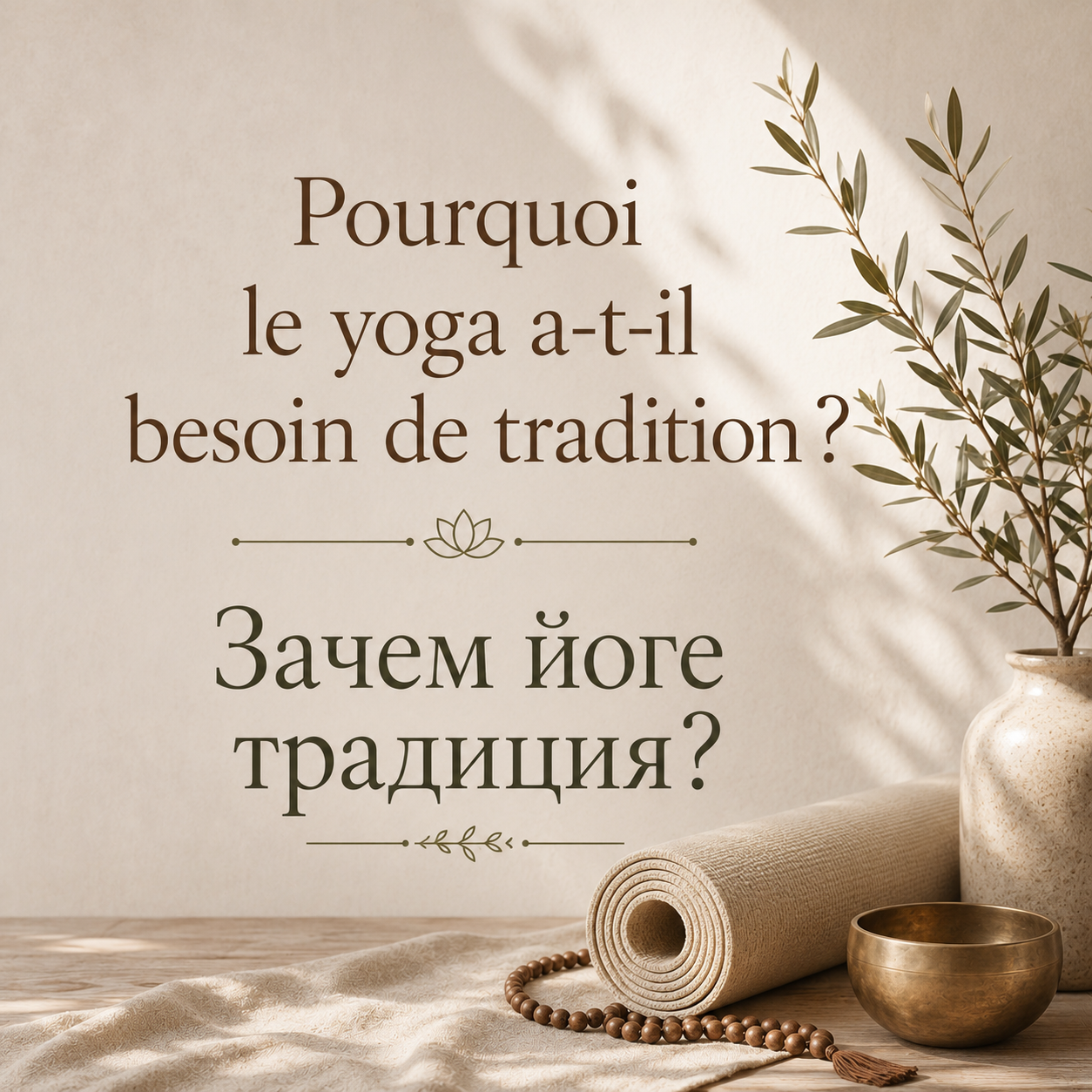
Aujourd’hui, le mot «yoga» est partout.
Today, the word “yoga” is everywhere.
- Yoga for the back.
- Yoga for weight loss.
- Yoga for stress reduction.
- Yoga for improving posture.
And all of this can indeed be part of yoga.
But sometimes, I feel like we are living through a special situation.
We have inherited many tools, but we are gradually forgetting where they came from and why they were created.
Imagine a person discovering the parts of a complex mechanism.
She learns to use some levers.
She masters certain buttons.
She even gets good results.
But she never saw the big picture.
The Yoga-Sūtras of Patañjali are somewhat of this plan.
They are not the only text on yoga.
They are not a manual of postures.
They are a map of how human consciousness works.
When Patañjali wrote his sūtras, he was not particularly interested in the flexibility or beauty of the postures.
Another question preoccupied him:
Why do human beings suffer?
Why, even when we possess health, security, or success, do we still experience some form of inner restlessness?
Why does the mind constantly travel between the past and the future?
Why is it so difficult to fully inhabit the present moment?
Centuries have passed.
Technologies have changed.
Cities have changed.
The pace of life has changed.
But human beings remain remarkably similar to themselves.
We continue to struggle with our fears.
We continue to worry about how others see us.
We continue to lose our inner balance when circumstances become difficult.
This is why the Yoga-Sūtras remain relevant.
They are not talking about a trend.
They are talking about human nature.
In modern yoga, a lot of attention is paid to postures.
Yet, Patañjali devotes only a few lines to them.
What interests him most is attention, inner discipline, self-observation, the quality of our relationships with the world, and our ability to remain stable in the midst of the movement of life.
For me, tradition is important not because everything that is old is necessarily true.
Tradition is important because it helps us not to lose our way.
When we return to the foundational texts, we discover that:
- Yoga is not simply a collection of exercises.
- Yoga is an exploration of the human being.
- The postures prepare the body.
Pranayama helps us to work with energy and the nervous system.
Meditation allows us to observe the movements of the mind.
But all these tools pursue the same goal: to help human beings become more conscious, freer and more whole.
Sometimes I like to imagine yoga as a big tree.
Its branches include the various schools, methods, and modern approaches.
They can be numerous and very different from each other.
But the roots remain the same.
And the more we understand these roots, the stronger our own tree becomes.
Studying the Yoga-Sūtras of Patañjali is therefore not a journey into the past.
It's an invitation to better understand each other in the present.